When you encounter stressful times in life, it is important that you take care of your spiritual wellbeing the same way you attend to your physical health. Spiritual health is a vital ingredient in maintaining a happy, healthy, energized and vibrant life. With so many economic challenges and negative, fear-based media coverage, it is imperative to take some quality time for yourself and ensure that you are giving yourself the care your body, mind and soul require. Just 10 minutes in the morning and evening spend in meditation can drastically reduce stress, eating healthy food, yoga and Reiki can assist you in combating stress and helping you to stay grounded, focused and aware.
The following article written by Jeffry Palmer is a wonderful, quick read and provides a check-list for you to access your spiritual well-being. Once you are conscious of limiting patterns it is easier to correct them. The fist step towards wellness and freedom is awareness. Once you are aware of your energy blocks, you can take action towards creating and maintaining a harmonious and healthy life.
Spiritual Health Checklist
Most of us are unaware of the health of our spirit or life energy. We go about our daily business without ever giving a second thought to this very vital part of our lives. For the majority of people, spiritual health is intangible, invisible the notion of the spirit is purely an idea or abstract concept, not a thing that can be monitored and measured easily like blood pressure or insulin levels. Yet our spiritual health is just as real and important as any other measurement of our well being. Lacking the modern devices and technology used to track physical illness, we must rely upon a routine of self examination and introspection in order to gauge the health level of our spiritual selves. The following checklist has been designed to help determine whether your spiritual health is in need of attention.
1. You find yourself more in agreement with negative points of view. 2. You are easily irritated or agitated, small things annoy you. 3. Beliefs that once seemed impeccable seem to have let you down. 4. You feel drained or tired most of the time. 5. Hobbies and interests seem less enjoyable. 6. You relive past events trying to determine when things went wrong. 7. Migraines and other ailments occur more frequently. 8. When you should be relaxing, you feel uncomfortable and nervous. 9. There always seems to be a void in your life which must be filled
Any or all of these issues may point to a serious need to address your spiritual health and well being. Considering the important role which spiritual health plays in our overall sense of happiness and fulfillment as well as the direct connection between spiritual wellness and physical health it is unfortunate that more attention is not paid to this vital area.
When the spiritual self is injured, the mind and body suffer. Take some time to examine your life path, your beliefs and expectations. Consider practicing meditation or other relaxation techniques to reduce stress and anxiety. Make a point of self evaluating the strength of your spirituality and take steps to connect or reconnect with the sense of wonder and mystery of life.
Examine your beliefs. Are your beliefs working for you? Is it possible that the beliefs that you have held for so long are actually damaging your spirit?
Of course it is. We often inherit the beliefs of our ancestors, community and cultures. Many times these beliefs simply are not compatible with we intrinsically know to be true. The resulting inner conflict can result in a sort of spiritual flu, an illness which we carry often for a lifetime and we can never seem to shake. No matter how good things may seem to be going, we always feel a certain kind of emptiness. Examine your beliefs and your entire belief system; do not be afraid to throw out any beliefs which feel at all uncomfortable. Your soul will thank you.
Modern medicine is based upon the notion of battle. We battle germs and fight for life. As soon as we feel pain or discomfort, we immediately try to change it. We feel we must conquer.
This way of being leads to a never-ending struggle. After one illness or problem is conquered, another arises. Usually we expect the doctor to take control and make us well. We relinquish our part in the illness, denying the fact that it is up to us to stop, listen, and discover the lessons the illness has to teach us. Healing from within brings inner peace with it. It arises from a different orientation towards all the experiences of life. We are taught to stop, pay attention, to respect what is happening – to see our pain as a messenger. It is as if we were re-focusing a camera, receiving our experience through a different lens.
Pointer 1 See Your Pain As A Messenger Bringing Important News
Dialoguing With Your Pain
Usually there is a deep sense that when pain arises it is because something is wrong. This is a misunderstanding. Pain arises from lack of balance. It contains much needed information, brings many messages along with it. When we see our pain as a messenger and learn how to really listen to it, healing begins in all kinds of ways. Some would suggest there is no difference between our physical pain, our illness and the emotional, mental or spiritual suffering we are going through.
Illness often comes when we feel defeated and may not want to struggle or live anymore. Some become ill when they are overly exhausted, which is a way of telling themselves it is time to make changes in their lives. Looking at one aspect of our suffering, we are also inevitably, looking at the next. All aspects are interconnected. In some cases, for full healing to take place, a person may have to make deep changes in his life. It is important to stop and wonder specifically what the pain is saying to you, to dialogue with the pain, ask fundamental questions of it: “What do you want from me? Why are you here now?”
No matter what we are feeling there is only one pain and it manifests itself in various ways. If we do not address it in one mode, often it will come in another. It can come physically, mentally, emotionally, spiritually. In whatever form this pain arises, it is extremely empowering to turn directly to our suffering and interact with it. This requires turning around. Instead of tensing up, we learn how to pause and understand there is a lesson here we have to learn. As we do this, we often discover that the pain comes holding a gift in its hands.
Pointer 2 Pain Often Comes Holding A Gift In Its Hands
Each Illness Has Its Own Story. The illness is the only way they can give themselves permission to stop, rest, and make much needed changes in their lives. Each illness has it’s own story. The same is true with psychological or emotional symptoms that grow strong, demanding our attention.
When someone is in physical pain and suddenly understands what is troubling them emotionally, the physical pain often startlingly subsides. For full healing to take place it may be essential to make changes in one’s total life. Cancer can be suppressed for many years, and then it returns. When it reappears we must ask, “Why now? What is going on in my total life?”
Sitting In The Middle Of Trouble
During the practice of Zen, students engaged in zazen (Zen meditation), sometimes sit for many hours on the cushion without moving. Sometimes incredible pain arises. As they continue to do this practice, they gradually become stronger than the pain. They learn to see that most of the pain simply comes from resistance to what’s going on. It comes from refusing this very moment.
When we stop fighting, we experience joy. Once we start fighting again, we are cramped into agony.
Pointer 3 The Best Way Out Is The Way In
The best way out is to make friends with the pain. Fighting intensifies it. If we can relax into it for a little while and explore, many new possibilities arise.
Natural healing is always available in all situations, but it can be cut off by fighting and by fear. When we let go and enter the flow of what’s going on at the moment, we became available to our greater source of energy, guidance and help.
Over the past ten years, the world of Western Reiki has undergone rapid change. In fact, not since Iris Ishikuro disobeyed Mrs Takata by making the Master Level commonly available has anything of the like happened (Mrs Takata had decreed US $10,000 to be the going rate for the course, thus putting it out of most people’s reach).
While there are several plausible reasons for this change – the advent of the Web, a growing number of teachers etc. – the principal cause is almost certainly the rediscovery of Reiki’s Japanese heritage. This has led many practitioners to question much that was previously taken as ‘gospel’, and delve more deeply into a practice they soon learnt was not just a healing system, but also a way of life.
The Problem with Western Reiki The Reiki almost everyone practices in the West was passed on – in one way or another – from Mrs Takata (a student of Dr Hayashi who, in turn, was a student of Mikao Usui, the founder of Reiki). Her style of Reiki has proven a great success and helped millions of people around the world. This is indisputable.
But is it true to Usui’s original system of Reiki? And, more importantly, is it as effective as what Usui originally taught?
The answer, I believe, is ‘no’, and the reason is that Mrs Takata focused too much on the healing component of Reiki. For her Reiki was – at least primarily – a hands-on healing technique; while for Mikao Usui it was something much grander: a path to Enlightenment.
Before I elaborate on this point, it should be noted that the difference in emphasis is not surprising given the way Mrs Takata and Mikao Usui found Reiki. Mikao Usui arrived at Reiki after a life of meditation, martial arts and (Tendai) Buddhism; Mrs Takata found it after she sought a solution to several life threatening health problems. As a result, Usui saw Reiki in the context of Buddhism (and hence, Enlightenment); and Mrs Takata saw Reiki in the context of healing. It is therefore only to be expected that the way they taught Reiki differed substantially.
The Five Building Blocks of Reiki Reiki, as taught by Usui, consisted of five principal parts:
• Attunements • Healing • Mantras and Symbols • Traditional meditation techniques • Reiki precepts
All five parts are seen to work symbiotically together: one part strengthening the other in a bid – ultimately – to find Enlightenment.
In Western Reiki (as taught by Mrs Takata) many of the five components are either lost or greatly weakened. They all exist, sure, but the emphasis – as we have explained – is on the healing. Everything else is useful only insomuch as it helps this.
The Quest for Enlightenment Since Reiki, for Usui, was not principally about healing (in fact, he only bothered teaching hands on healing in the last few years of his life!), then it is worth examining how it fits in with the goal of Enlightenment . In particular, it is useful to re-examine the five building blocks of Reiki to see how traditional Usui Reiki differs in emphasis from that handed down by Mrs Takata.
The Attunements The attunements are for the most part used in a similar way in both Western and Japanese Reiki. Their purpose is to connect the aspiring practitioner to Reiki energy. The principal difference is that in Japanese Reiki the attunements (reiju) are not a one off thing. Rather, they are performed over and over again to help maintain one’s connection to the Reiki energy.
In fact, in Usui’s time, it was even common practice to perform reijus each time Reiki practitioners met as a group.
Healing As we have already said, healing for Usui was not so much an end in itself as a path to Enlightenment. Through healing you entered into a deep meditative state that led to a closer connection with the true Self.
That is not to say that the healing component wasn’t valued. After all, Usui himself spent much time healing people (sometimes even doing so for days on end – for instance after the 1923 Tokyo earthquake). The point is simply that healing was of secondary importance. It was the spiritual state of an individual that truly mattered. Not surprisingly, Japanese healing sessions tend to be much more intuitive as a result, since the emphasis on the meditative element makes them less ‘heady’ than their Western equivalent.
As a rule, there are no set positions, with a practitioner moving intuitively from one place to the next (unlike the method Mrs Takata taught which involves students using a set of fixed hand positions).
Mantras and Symbols In Western Reiki, the mantras and symbols are primarily used to strengthen healing. If the practitioner feels that more energy is needed on a certain part of a patient’s body, for instance, the Power Symbol can be drawn to intensify the Reiki energy. The mantras and symbols are generally used together – the mantras being repeated after the symbols are drawn.
In Japanese Reiki the symbols have a role of lesser importance. Indeed, the best way to describe them – according to Frans Stiene – would be something like ‘training wheels’. While a beginner practitioner has a less reliable (or weaker) connection to the Reiki energy they will be used; but as soon as the practitioner has learnt to embody the energy of the symbols they will be let go of.
Furthermore, the symbols are used more for the practitioner’s sake than the client’s. They are not drawn on the client so that he or she can receive ‘more energy’. Rather, they are drawn by the practitioner so that she, herself, can better embody their energy.
Another key difference between the two Reiki systems is that in Japanese Reiki the mantras are often used on their own. They are generally chanted with the aim of strengthening certain energy centers (for instance the CKR mantra – that is pronounced slightly differently to normal – bolsters the hara, or second chakra).
Students will spend months – maybe even years – chanting these mantras, working their way from one to the next only when their teacher deems them ready for the next one.
Traditional Meditation Techniques As a rule, traditional Western Reiki neglects meditation practice. Sometimes meditation techniques involving the visualization of the Reiki symbols are taught, and students are usually encouraged to be in a meditative state when practicing Reiki; but systematic meditation is seldom part of Western Reiki.
For Usui, on the contrary, meditation was a genuine cornerstone upon which Reiki developed. Using particular meditation techniques – in particular breathing into the hara – students learnt to focus their mind, strengthen their energy and merge with the true Self.
Since Reiki – as we have said – was for Usui a path to Enlightenment, then moving more deeply within oneself was the most important thing one could do. As such, it is hardly surprising that Usui taught meditation for many years before teaching the healing component of Reiki.
Healing the body is great, for sure; but healing the mind (through meditation) is more important still.
Reiki Precepts The Reiki precepts are taught in both Western and Japanese Reiki and, to some extent, are important to both. The main difference between the two systems is how they are used.
While in Western Reiki the precepts are often understood on an intellectual level, Japanese Reiki aims to understand them in a more intuitive, non-rational way. Practitioners meditate on them, trying to understand with the ‘gut’, not the head. In this way, it is hoped, they can more fully embody the principles (in both actions and spirit).
When the principles are understood with the head alone, students will generally find that they do not greatly influence their actions.
Conclusion Due to the multiple developmental influences on Western Reiki – for instance, Indian, Tibetan and Egyptian to name just a few – it is impossible to make any statements that are valid for all of its forms. That said, it is nevertheless true that on the whole, Japanese Reiki is principally a path to Enlightenment, while Western Reiki is a path to healing. This, it could be argued, is the main difference between the two systems. (Note: This discussion should be seen as a general one. In other words, as accurate as it will often prove to be, many Reiki practitioners and systems will not conform to the ‘norm’.)
Live in the now. The past is gone. You can never go back and make it right. You can never re-live a life that was yesterday. Live positively in the present moment, no matter what is occurring. It is All right and perfect. Do not look ahead and dread what may come. Our mind creates a lot of chatter and makes us afraid in order to keep us safe. Tell your mind “Thanks for sharing” and affirm “I am here, I am present”. You are always at choice and you know how to make this day beautiful.
2. Nature
Sit on the lawn or next to a tree. Feel the pulse of the earth, the grandeur of the sky, the coolness of the breeze on your face, or the warmth of the sun on your face. Smile at nature, say hello to the bugs and all the animals you meet. Take a walk in a park or hike on a trail.
3. Exercise
Daily exercise gives you a break from your mind chatter, helps pump your heart, circulates your blood, clears toxins from your body, charges you with energy and has many other benefits. Choose an activity that is fun and mix it up. Do walking one day and yoga another day. Take a Tai Chi class and meet new people. The list of possibilities is endless.
4. Spirituality
Recognize and know you are important and unique. Meditate, or sit quietly, and be in the moment. Read books that are uplifting and have positive messages. Give thanks for your health, your home, your friends, all the joy and happiness in your life and all the good that surrounds you.
5. Forgiveness
It is time to let it go. Forgive all parts of yourself to be whole and perfect. Forgive yourself for any past mistakes or shortcomings; forgive the child within for being afraid; forgive the teenager that spoke words of anger; forgive the young adult for not being a risk taker. Forgive others in the past. Forgive your parents, your siblings and relatives. Let go of all grudges. Forgiveness is about coming to peace within yourself.
6. Bubble Bath
Give yourself permission to relax and savor quiet times. Read a book for fun. Spend that extra money and get a massage or a facial. Do something selfish for yourself.
7. Nutrition
Listen to your body. Feed it good nutritious food. Take a high quality multi-vitamin or a liquid supplement. Most health challenges can be reduced or eliminated with a dietary supplement.
8. Let Go of Judgment
Give up judgement and give up blame. Never speak critically of others or yourself. Speak words of encouragement to yourself and everyone you meet. Accept everyone for who they are and embrace their differences.
9. Service To Others
Reach out and lend a hand to a friend in need. Offer unconditional service to others. Be a great listener and really listen to people when they speak. Find ways to help others to lift their spirits and help lessen their burdens.
10. Love
Love yourself and use positive words of encouragement. Compliment strangers and make others smile. Speak from a loving heart and shine with joy.
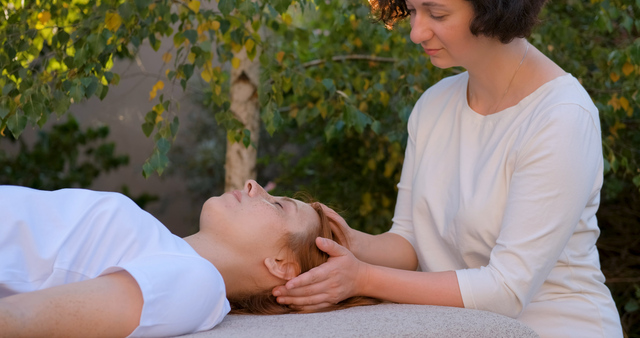
What is Reiki? The word Reiki is Japanese and means universal life force energy. A simple and profound method of healing, a Reiki practitioner places her hands on or above the client’s fully clothed body and directs healing. This loving energy flows gently through the client, supporting her not only physically, but also mentally and emotionally. Reiki soothes and relaxes, balances the energy field, and supports the body’s natural ability to heal itself.
How does it help pregnant mothers? Reiki is a wonderful gift to expectant mothers and their babies. In early pregnancy it can reduce many of the common discomforts such as exhaustion and nausea, ease stress, and promote relaxation. Throughout pregnancy, Reiki can provide relief as the mother’s body grows and changes, and can address issues such as lower back pain, tension in the neck and shoulders, and insomnia. On a mental and emotional level, Reiki can ease anxiety and fear in a woman who is unsure of herself and her body as childbirth approaches or who worries about motherhood. Relieved of some of the physical and emotional discomforts of pregnancy, the expectant mom will sleep more soundly and feel more relaxed, positive and connected with her baby.
How does it affect babies? Reiki is also highly beneficial for babies. They are in tune with the loving energy flowing through their mothers. Growing babies have many needs and it is just as important that their energy be balanced. Connected to their mother’s thoughts, moods, and emotions, babies feel the sense of calmness and peace created by Reiki. What a wonderful way for mom and baby to bond!
Can Reiki be used during labor? During labor, Reiki is effective in easing pain and creating a peaceful atmosphere for mom and the baby. Reiki can ease muscular tension, lower blood pressure, aid in relaxation and energy conservation, help mom to focus on breathing, and provide a safe, non-invasive form of pain relief.
What about after the baby is born? Once the baby has arrived, Reiki can assist mom with physical healing and also help her regain balance in her transition from pregnancy into motherhood. Nurturing mom with Reiki helps her nurture her infant and also affirms the importance of her continuing need for self-care as she steps into a new phase of life.
A Reiki session is a wonderful and powerful experience; after receiving a session you truly feel much improved. It is a good standard for a practitioner to offer an hour treatment so that the client’s entire body can receive Reiki energy. On the other hand, I have had experiences which have yielded powerful results after giving or receiving Reiki for only a few minutes; intention is the driving force when sending Reiki. Each situation is different, and it is better to get Reiki for five minutes than not at all. Even with a very busy schedule, Reiki can be easily woven into the fabric of your life so that you effortlessly do Reiki throughout the day.
Many say they don’t find the time to practice Reiki. Others, who are professional Reiki practitioners, give Reiki to their clients, but don’t seem to find the time to receive Reiki. The more the better is my motto. So as you do Reiki frequently throughout the day, even though you haven’t set aside the time to do a traditional Reiki session, you have send quite a bit of Reiki energy.
Let’s look at some of the ways you can do this:
• As you wake up in the morning, take a moment to send Reiki to your day with the distant healing symbol and give yourself Reiki for a few minutes somewhere on your body as you wake up.
• When you have breakfast, or any meal, add Reiki to the food. Reiki energy penetrates at a cellular level so that the molecules of your food are receiving life force energy; thereby increasing the nourishment and pleasure you receive when you eat it.
• If you bring water with you, charge a small crystal with Reiki and place it in the bottle. You will be drinking Reiki crystal water all day.
• Reiki symbols around your car. I draw or visualize the Power Symbol 3 times while saying, “CKR, CKR, CKR bubble”. When I do this I sense a bubble, popping open like an umbrella, around my vehicle.
• Put crystals charged with Reiki in your car and place those photos on your Reiki crystal grid to keep the crystals charged and cleared all the time.
• A red traffic light is a signal that you have time to do Reiki!
• As I drive down the road I send Reiki to people driving badly, prisoners working on the roadside and the trees and birds I see along the way.
• If I am lucky enough to have time to take a walk in the park in the morning, I send Reiki to the trees, plants and animals I see there. I also send Reiki to the spirits of the ancestors of all who lived before me on the land. By now you might be thinking that I spend my whole life just walking around doing Reiki, but actually after awhile it just becomes quite natural and is done automatically, like breathing or blinking your eyes. Look how much Reiki I have done and I haven’t even made it to work yet.
I have been a Reiki Master for many years and feel truly blessed to have Reiki in my life. One of my great joys in life comes from sharing this Japanese healing technique with others. Whether I am teaching a Reiki workshop or giving a Reiki healing session, it always amazes me how this sacred spiritual energy can easily and effortlessly help transform and empower each individual who experiences the Reiki energy. I receive many questions from people who wonder what Reiki is, how Reiki can benefit them and what the health benefits are.
WHAT IS REIKI?
Reiki is an ancient Japanese healing technique for stress reduction, deep relaxation, release of pain and expanded spiritual awareness. Reiki is a powerful, yet very gentle mode of energetic healing and balancing wherein the body’s own natural healing abilities are activated and accelerated. Reiki heals on all levels including emotional, mental, physical and spiritual.
Working with the energetic system of the body, Reiki balances and aligns the body, helping you to connect with the Life Force within. Everything in the universe is composed of Energy, including you!
When your Life Force Energy is strong, healthy and flowing, you are happy and healthy. But when it is low, then you are more prone to get sick, feel stressed and tired. Reiki helps you find your balance again so that you can live life fully, experiencing feelings of well-being, vitality and joy. Reiki is a safe, gentle, non-invasive and natural method of healing and self-care.
HOW CAN REIKI HELP ME?
A Reiki session can be a beautifully tranquil experience. While receiving a Reiki treatment, you will find yourself in a comfortable environment, relaxing to soothing music, which easily induces a deep and peaceful meditative state. It is in this relaxed state of being that the body opens up to its own inherent healing abilities and is more conductive to receiving Reiki energy. The cares of the day melt away as you are drawn deeper and deeper into the blissful and rejuvenating experience. Many people have reported life-changing events taking place after receiving Reiki. There is literally no limit to the healing and personal growth processes, which can be achieved through receiving Reiki healing energy.
Experience the healing hands of Reiki for yourself!
THE BENEFITS OF A REIKI TREATMENT: – Releases stress – Amplifies Energy – Balances Energy – Helps Release Emotions – Increases Creativity – Increases Awareness – Decreases fatigue – Improved sense of well-being – Boosts the immune system – Increased physical vitality – Releases feelings of Anxiety
“Allow the light to be. May we be free of a past of pain and confusion. May we let our wombs, our hearts, be filled With their own natural light. May we be whole unto ourselves. May we be at peace. May all beings be free from suffering.”
What have you been focusing on lately? On how well life is going for you? Or on how much business you’ve been doing compared to last year, or how well your superiors have been rating you? Or on how much your partner loves you and how much you revel in the relationship you’re having? On the excellent state of your bank account? On your ever-present good health and slim and trim physique? Or on the joy you experience each time you sit down to dinner with your teenage children? On the wonderful vacation you came back from recently and the even more exciting one you are planning for the near future? Or on the good way you feel about yourself and all the things you are creating and doing with your life?
What You Think is What You Are I can just hear you spluttering. “What kind of romantic thinking is this? Where do these ideas come from? I don’t know anybody who thinks like that.”
True. Most people don’t think like that. In fact, most people think the exact opposite of that. Most people concentrate on all the things that are going wrong with their lives. Most people spend much of their time thinking about their problems and wondering how they are going to solve them. Most people think about all the things that could go wrong with their lives or about the people or events that stand in the way of their success. Most people think and think and think about whatever it is that worries them, because they believe that that is the way to resolve the problem. The fact is that most people focus so much on what they are afraid of, or what bothers them, or what stresses them, or what they don’t know how to solve, that they are giving all or most of their conscious and subconscious energy to a negative outcome – the problem.
What Kind of an Outcome Do You Want? Consider this: the more you give your energy to one thing, the more that thing has a possibility of coming into being. If you concentrate on getting a university degree, you will most likely achieve that goal. If you concentrate on writing a book, you will again probably achieve that goal. But what happens if you continually tell yourself, while you are concentrating on getting the degree, that you are not intelligent enough to pass the exams, or that you simply are incapable of understanding the course material? And what happens, if you continually tell yourself while you are concentrating on writing the book, that you will never be able to write well, or that your story is not good enough? Obviously you are not only undermining yourself and sabotaging your desired outcomes, but you may also be creating a self-fulfilling prophecy.
Focus and Intention So what can you do? Let’s assume you are convinced that you lack the intelligence to pass the exams. Or that you are convinced that you will never write well. You have a goal, and that goal is to get a degree or to write a book. In order to focus on that goal, your mission is to ensure that your thoughts are aligned with – or intentionally focused on – that goal. Therefore, whenever your thoughts stray from the goal into negative territory, you need to pull them back into the arena of positive results.
Goals and Fears But focusing on a desired goal is very hard for a very simple reason: we are far too used to focusing on the fears surrounding the goal (I am so afraid I will never have a great relationship, rather than imagining in your mind’s eye the great relationship in the way you want it to be; or how will I ever get that promotion rather than imagining in your mind’s eye the way you will feel when you do get the hoped-for promotion).
How to Focus So how do you focus? When you worry, and your mind goes around and around a problem, or some stress in your life, you are very focused on the problem. It is exactly at that moment that you need to re-focus and see your desired goal or outcome in your mind’s eye, rather than all the problems you associate with it. The more time you spend on whatever it is you want to have in your life – whether this is a material goal, a professional goal, a relational goal, or whatever – makes absolutely no difference, the more you will be in a position to achieve it, to attract it into your life. The more you think – and focus – on that goal in a positive way, the more you allow yourself to “feel” the way you would feel if you already had the results, the more likely it is that you will attain your desired outcome. This is the Law of Attraction.
Intentionally Re-focus on the Positive Remember: the time you spend worrying about the desired outcome is time spent focusing on the opposite of what you want, so become very aware of all your thoughts and focus them in the right direction. Do this consistently each time you catch yourself thinking the negative version of your goals until intentionally re-focusing on the positive becomes second nature. This habit is like strengthening a muscle, if you do it every day, it will happen more and more frequently and naturally, and soon you will find that not only do the majority of your thoughts and feelings focus on the positive direction of your goals, but that those positive goals become part of your reality.
Our purpose in life is to be happy. That’s why we are here. We spend much of our lives pursuing what we believe will make us happy, but what we fail to realize is that happiness is a feeling and just thinking about what makes you happy will give you that feeling. You don’t need any thing to make you feel happy, you only need the thought and you will experience the happiness.
If you want a new job, imagine being in the position you want and earning the salary you desire; by doing so, you already have the feeling of happiness even before you get the job. Of course, you still want to get the job, since you can’t go shopping with your feelings, but the end result is already yours. You have already created the job, in your mind, by having the feeling. All you must do is to allow it to materialize and take the steps you feel are necessary. You might want to brush up on your skills so when your interview comes around you are more qualified and prepared.
The sense of accomplishment, opportunity to work at something you love and the increased income, which you associate with your new job, are created by thoughts. Thoughts are real and will attract that situation, or a similar one, into your life. On the other hand, since you already have the happy feeling, you might decide you like your current job. Either way you can’t lose since, no matter what the outcome, you’re already happy.
To quote Wallace Wattles from The Science of Getting Rich, “Man must pass from the competitive to the creative mind; he must form a clear mental picture of the things he wants, and hold this picture in his thoughts with the fixed PURPOSE to get what he wants, and the unwavering FAITH that he does get what he wants, closing his mind against all that may tend to shake his purpose, dim his vision, or quench his faith.”
We were all born happy. As small children we played, laughed and giggled throughout the day. We didn’t need anyone to tell us what we desired; in fact, we were willing to throw tantrums in order to get our way. We ate what we wanted and did as we pleased; resisting, without hesitation, anything we didn’t like. At that young age, when we became unhappy, we protested wholeheartedly by crying, kicking, screaming or trying to run away. Happiness was so essential to us then, we were willing to put 100 percent of our energy into anything that would help us attain and preserve our happy state. If we wanted a toy and it was given to us, we were delighted and totally content. If our plaything was taken from us, it became an overwhelming tragedy.
As we got older, we learned to accept that which didn’t make us happy–setting aside what we really desired. In addition, we learned that there are things we must do whether we liked it or not; that’s just the way life is. That was the lie we chose to believe, but it’s not the way life is supposed to be. You don’t have to accept or settle for anything. All you have to do is to have the intention to be happy, remember how it feels to be happy, and decide that you are happy.
To put it simply, the act of meditation involves quieting the mind so you can open the heart. That’s it in a nutshell.
We often believe our hearts are open and we can feel much of what is going on in our lives. Yet to truly open the heart means we have to stop the thinking, the judging, the opinions, the analyzing, the questioning, the doubting, and just love. It’s all that unconditional stuff. The act of doing this, takes practice and patience. Learning to meditate means learning to love. To love our self. To love all others. To love the oneness of all. To love more.
The connection you feel when you ‘plug in’ to this oneness is the most irresistible state of love you will ever feel. Makes it sound like it’s worth the effort doesn’t it? Maybe you’ve had glimpses of this – moments when you felt it, and your heart expanded. The beauty of nature in a spectacular sunset or a magnificent rushing waterfall, a child’s innocent embrace, a long awaited accomplishment, an exhilarating sport or excursion, being with the one you love.
These can make you ‘feel’ in the biggest sense of the word. And the feeling can be described as wonderfully peaceful, coupled with a glorious uplifting, a lightening up of the heart. What these experiences all have in common is an external factor. Something had to be there, something had to be seen, in order to involve our senses. These ‘things’ serve to trigger this feeling.
Meditation serves the same purpose. It teaches you to connect with this feeling all on your own, without any outside stimuli. The source of that loving feeling is always within you. But what happens most often is that you don’t know how to access it on our own. You wait for the triggers, look for the triggers, and in fact even seek out the triggers, because you believe they are the source.
When you quiet your mind, you are closing down the outside stimuli. You are holding the mirror up to yourself, deep within yourself, and waiting to see/feel the love. It’s there, but the practice is necessary to learn to wait quietly, build patience, and stroke and nurture your loving heart.
Most of us have shy hearts and loud minds, and meditation serves to reverse this so we can truly feel the bliss and the joy and the ‘highs’ we so crave in our lives. Now, meditation can be made to be much more complicated than what I have described. There are countless books, tapes, courses and workshops that deal with the core principles of meditation, and then expand upon them. They go into many, many aspects, avenues, theories, understandings, types, etc. It can be quite overwhelming for the beginner. But it’s perfect for the intermediate student of meditation.
When you are beginning, the less said the better. Keeping it simple is very important, because the process of meditation is so simple. If it’s not working, or if you want to know more about it, or you are ready to know more about it, then by all means read, study, learn. It’s like taking the same route to the supermarket every day and then finding out there are other ways of getting there, other roads that lead there, other journeys you can take.
Study and practice of meditation has the potential to open up many layers of your heart. Everything in your life therefore opens up with it. Relationships bloom, work purpose is found, vibrant health is allowed, because love affects your belief system, your attitudes, your choices. Anger dissolves before it ever manifests, frustration mellows out, the pit of sadness and depression are filled up like never before. These are the promises of meditation. These are the long-term rewards. But in the beginning, meditation is simply quieting your mind so you can open your heart.